


40–80% Less Manual Work and 20–50% More Large Orders
About the Client
The Client is a US-based division of a global industrial manufacturer founded in 1960 and headquartered in Germany. With around 2,000 employees worldwide and a network of 45 sales representatives across five continents, the company operates at a truly international scale while remaining family-owned.
The organization began manufacturing circular connectors in the late 1960s and has since evolved into a leading producer of high-precision connectors and electrical components for automation, engineering, robotics, medical technology, and advanced electronics. Their products are technical, specification-heavy, and designed for demanding environments, featuring industrial-grade standards such as IP67 protection and certified quality systems (ISO 9001, ISO 14001).
The primary buyers are professional users, engineers, procurement specialists, OEMs, and distributors who require detailed technical documentation, configuration options, and, in many cases, custom solutions tailored to specific applications.
This is not a commodity business. It’s a complex, specification-driven industrial sales environment operating across multiple continents.
The Client’s website is the primary digital touchpoint and acquisition channel, attracting 108K+ monthly visitors. Over the years, the marketing team invested heavily in SEO and content architecture, making the website’s stability and URL structure a critical business asset.
The Client's Main Challenges
The main website runs on TYPO3. Internal teams were satisfied with the design, structure, and performance, but the site lacked modern B2B transactional capabilities such as:
- customer-specific pricing
- stock visibility
- quote-based ordering
- self-service purchasing
The website worked well as a content and discovery platform but failed to support the next stage of the buying journey.
As a result:
- customers researched products online
- but completed purchases via email or phone
This created friction and limited scalability.
At the same time:
- competitors were investing in digital channels
- customer expectations were evolving
A full rebuild was not acceptable due to:
- SEO risk
- operational disruption
- ERP/PIM limitations (file-based, not API-driven)
Main Challenges Customer Faced
Business Challenge 1
Full B2B eCommerce Without Rebuilding
The website lacked:
- checkout
- dynamic pricing
- stock visibility
- account management
- cart
- quote requests
Rebuilding raised concerns:
- cost
- SEO risks
- long timelines
Goal: Add enterprise commerce without breaking the existing system.
Business Challenge 2
Personalized Pricing Without UX Rebuild
Required:
- customer-specific pricing
- tier discounts
- embedded cart
Goal: Prove Magento can act as a service layer without changing CMS.
Business Challenge 3
Manual Data Not Scalable
Needed:
- automated catalog sync
- real-time stock
- reliable checkout
Problems:
- manual updates
- inconsistent availability
Goal: Build a reliable commerce engine with automation.
Business Challenge 4
Large Orders Require Approval
Previous flow:
- cart abandoned
- email sent
- manual response
Goal: Keep users in funnel with quote-based flow.
Business Challenge 5
No Localization
Issues:
- limited usability for non-English users
- lower conversion
Goal: Enable EN / ES / FR without architecture changes.
Technical Challenge
Magento + TYPO3 Headless Integration
Magento handled:
- pricing
- cart
- checkout
- accounts
- stock
TYPO3 handled:
- pages
- SEO
- UX
Key requirements:
- API integration
- shared sessions
- daily sync (~5,000 SKUs)
- stock updates every 30 min
- XML via FTP
Rejected options:
- SaaS (integration limits)
- full migration (SEO risk)
- custom CMS checkout (too complex)
Delivery Challenge
Go Live Without Risk
Constraints:
- 4.5K+ daily users
- no downtime
- no SEO impact
Concerns:
- performance
- security
- reliability
Team & Timeline
| Role | People |
|---|---|
| Full-stack engineer | 1 |
| QA Engineer | 0.5 |
| Project Manager / Analyst | 0.5 |
Total timeline: 5 months
What We Did
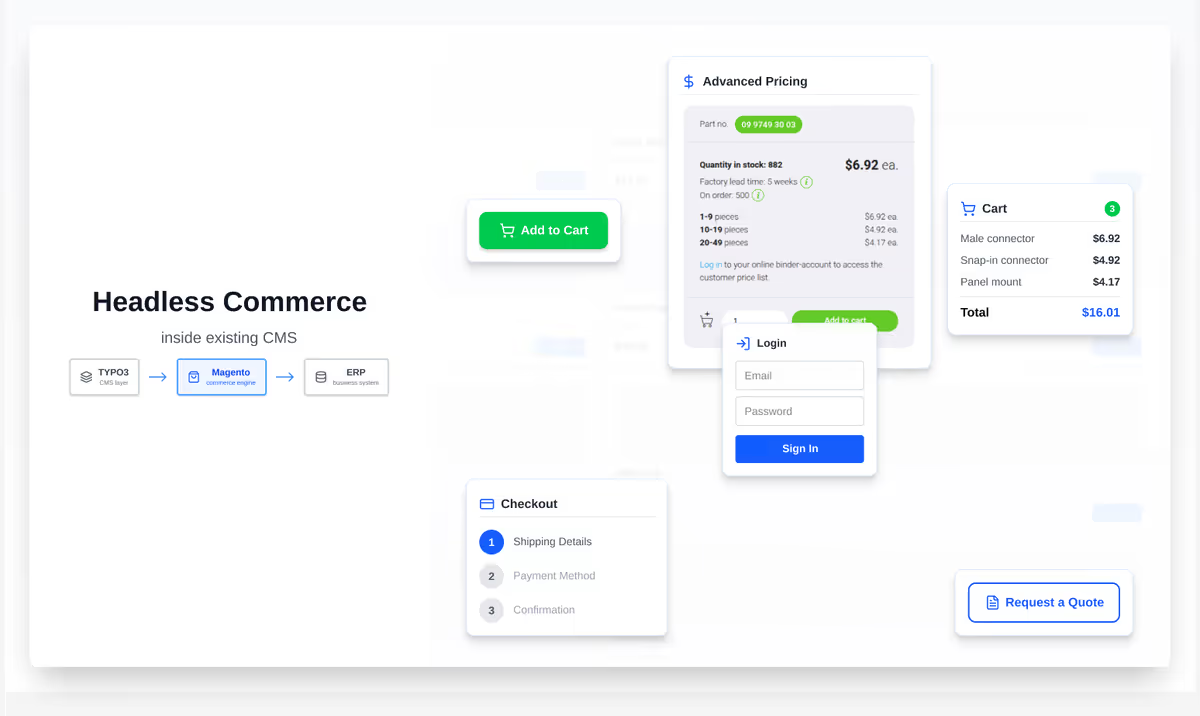
Solution 1: Headless Magento Integration
- kept TYPO3 as main site
- Magento on subdomain
- shared auth via cookies
- unified UI
- blocked Magento from indexing
Result: Commerce added without SEO risk.
Solution 2: Proof of Concept
- Magento with sample products
- tier pricing configured
- JS snippet injected into TYPO3
- AJAX → Magento API
Displayed:
- personalized price
- add-to-cart
Result: Validated approach without rebuild.
Solution 3: Data Sync + Checkout
- daily sync (~5K SKUs)
- stock every 30 min
- real-time API
Checkout:
- UPS / FedEx
- Credit Card / PayPal / PO
Search improved with:
- weighting
- synonyms
- typo handling
Infra:
- AWS + Docker
- Cloudflare
- New Relic + Sentry
Solution 4: Quote Flow
- threshold: 249 units
- cart → quote
Result:
- no drop to email
- better conversion
Solution 5: Multi-language
- EN / ES / FR
- consistent flows
Key Results
- 40–80% less manual work
- 20–40% fewer errors
- 20–50% more large orders
- zero SEO impact
- delivery in 5 months
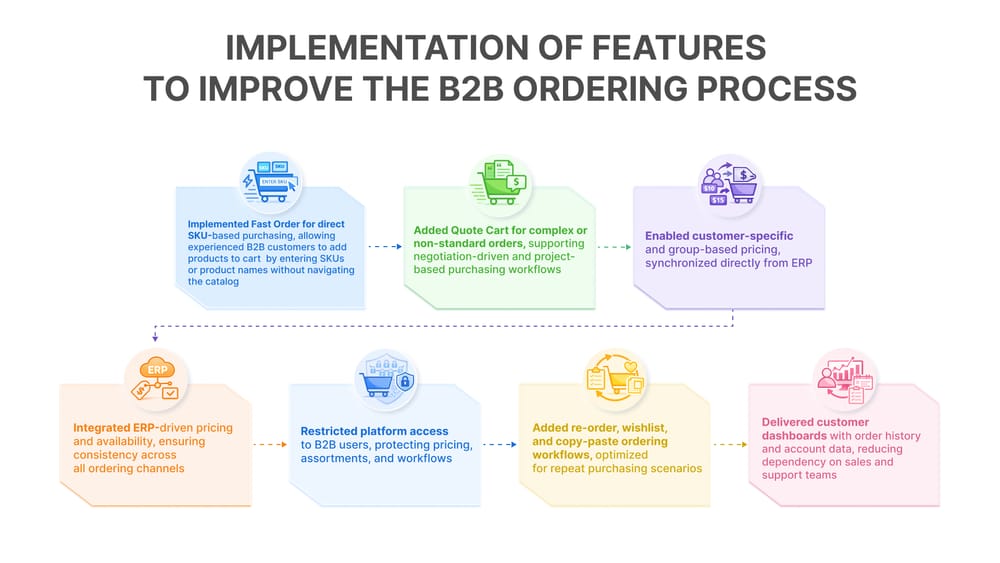
Features Delivered
- Headless Magento + TYPO3
- Automated product sync
- B2B checkout
- Cart → Quote
- Multi-language
- Enhanced search
Technology Stack
- Magento 2
- TYPO3
- Elasticsearch
- AWS
- Docker
- Cloudflare
- New Relic / Sentry
- XML importers (FTP)
- ShipperHQ
- Payments: Card / PayPal / PO
Final Note
This project shows how to introduce eCommerce without rebuilding.
Key outcomes:
- SEO preserved
- system stable
- commerce scalable
- resilience ensured
Even if commerce fails — the site still works.
Delivered in 5 months by a small team.
Read the full case study: Headless B2B commerce on Magento 2 inside an existing TYPO3 website.
'%3e%3cellipse%20cx='508.5'%20cy='387.5'%20rx='324.5'%20ry='234.5'%20fill='url(%23paint0_linear_74_1900)'/%3e%3c/g%3e%3cdefs%3e%3cfilter%20id='filter0_f_74_1900'%20x='0'%20y='-31'%20width='1017'%20height='837'%20filterUnits='userSpaceOnUse'%20color-interpolation-filters='sRGB'%3e%3cfeFlood%20flood-opacity='0'%20result='BackgroundImageFix'/%3e%3cfeBlend%20mode='normal'%20in='SourceGraphic'%20in2='BackgroundImageFix'%20result='shape'/%3e%3cfeGaussianBlur%20stdDeviation='92'%20result='effect1_foregroundBlur_74_1900'/%3e%3c/filter%3e%3clinearGradient%20id='paint0_linear_74_1900'%20x1='227.37'%20y1='272.209'%20x2='619.387'%20y2='679.264'%20gradientUnits='userSpaceOnUse'%3e%3cstop%20stop-color='%23863CF9'/%3e%3cstop%20offset='0.239583'%20stop-color='%23B887F4'/%3e%3cstop%20offset='0.494792'%20stop-color='%239FB4FC'/%3e%3cstop%20offset='0.776042'%20stop-color='%23B7E4BB'/%3e%3cstop%20offset='1'%20stop-color='%23FCFD64'/%3e%3c/linearGradient%3e%3c/defs%3e%3c/svg%3e)